
- by Mike
- 0 Comments
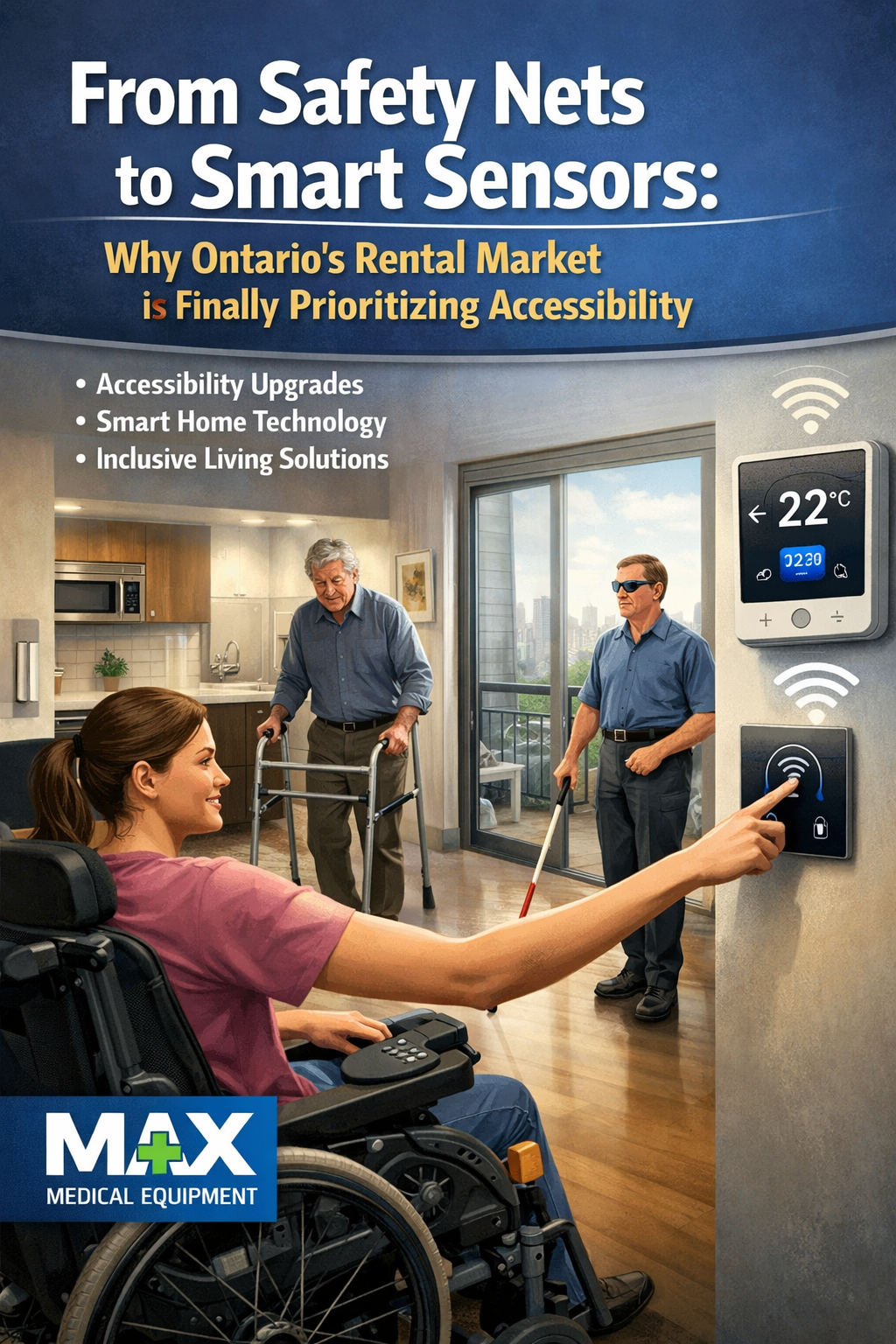
For decades, “accessibility” in the Ontario rental market was a reactive measure—a safety net thrown out only after a crisis had happened. The grab bar was added after a tumble, and the ramp was constructed after being discharged from a hospital. But that story across the Greater Toronto Area (GTA) has shifted fundamentally since late 2026. The net is evolving beyond simple “safety” nets to complex systems that act like integrated “smart sensors.”
In boomtowns like Vaughan and Richmond Hill, landlords, developers, and families are ready to consider accessibility as more than just a compliance checkbox. Instead, they are taking it as a high-tech lifestyle standard. This transformation is powered by a generation of seniors and recovery patients refusing to settle for clinical safety or the comfort of home.
Revolutionary Discovery—The Smarter Home Care Sensor
The most significant shift in 2026 is the hardware bringing “intelligence” into our homes. Those days of clunky, stand-alone medical devices are long gone. The accessibility tools of today are part of an interconnected ecosystem that helps prevent emergencies before they occur.
Key Innovations Defining 2026
- Predictive Fall Sensors: AI-enabled sensors embedded in floorboards and bed frames that measure subtle gait changes (or “restlessness”) that often occur before a fall.
- Haptic Safety Rails: Bed rails that send gentle vibrations to alert a patient if they are getting too close to the edge of the bed or if a rail is not fully locked.
- Silent Triage Systems: Rather than ringing loud alarms that heighten anxiety, smart sensors send encrypted alerts directly to a caregiver’s smartwatch or at a nursing hub in a “micro-hospital.”
The Economics of Modern Accessibility
This move toward high-tech home care has spawned a sophisticated rental economy. Families are learning that they don’t have to own $10,000 pieces of equipment to get world-class care. They can use the latest technology on a “pay-as-you-need” basis.
And in the northern GTA, this flexibility is vital to navigate high living costs. When designing your in-home recovery suite, you can expect to pay between $150 and $200 a month for fully electric, “smart-ready” hospital beds available in 2026. These packages often come with professional “white glove” setup, which means the smart sensors are calibrated and working properly on the home’s Wi-Fi network well before a patient arrives.
Richmond Hill: A Study in Seamless Integration
Demand is especially strong for these services in affluent residential pockets where multi-generational living is common. The goal in these communities is “invisible accessibility”—equipment that delivers ICU-level support without the house looking like a clinic.
Prompted by rising prices, the transfer of patients from hospital to home is now mediated by “care concierges” who orchestrate the entire arrangement for many families. It has become common during the recovery process to order a high-end hospital bed for home use in Richmond Hill that offers wood-grain finishes and concealed medical ports. This means the senior or patient can recuperate in a space that retains the characteristics of a bedroom, under the bemused gaze of silent smart sensors.
Why the Rental Market is Taking a Lead
But primarily, why now, in the rental market? The answer is in the pace of innovation.
Technology lifecycles: Medical technology is advancing at such a rapid pace that a bed bought today might be outdated by 2028. Renting lets families trade in for the new “Smart Sensors” every couple of months.
Zero-Maintenance Stress In 2026, rental agreements in Ontario come with 24/7 technical support. If a smart sensor disconnects or a motor starts humming, the provider takes care of repair or replacement right away.
Personalized Recovery: “Smart” levels vary across periods of the recovery process. A patient might require a high-dependency bed for the initial portion of a month and then switch to a low-profile “lifestyle” bed for the second.
The Role of Government & Insurance
The switch has not happened in isolation. New changes to provincial guidelines are also beginning to encourage “Smart Home” retrofits in Ontario from 2026 onwards. Programs including the Assistive Devices Program (ADP) have broadened the aperture of what they’ll reimburse, covering a portion of costs for connected devices, accepting that a $50-a-month sensor is far less expensive than a $50,000 hospital stay.
And on a rental level, new projects in Vaughan are being constructed with “accessibility-ready” infrastructure—including reinforced walls for ceiling lifts and separate electrical circuits to support medical beds—as standard features to appeal to long-term tenants high in value.
Conclusion: A New Standard of Dignity
The shift from “safety nets to smart sensors” is more than a technological updating; it is a move toward dignity. By prioritizing accessibility in the rental market, we’re making sure a medical condition doesn’t drive someone out of their community.
In 2026, a great Ontario home isn’t measured only by its square footage or the finishes with which it spices up its kitchens—it’s how well it protects what’s inside and those who call that space home. While Vaughan and Richmond Hill lead the charge, the rest of the province is taking note—understanding that tomorrow’s health care won’t be sitting in a hospital but rather in a smart home made accessible.