
 23February 2026
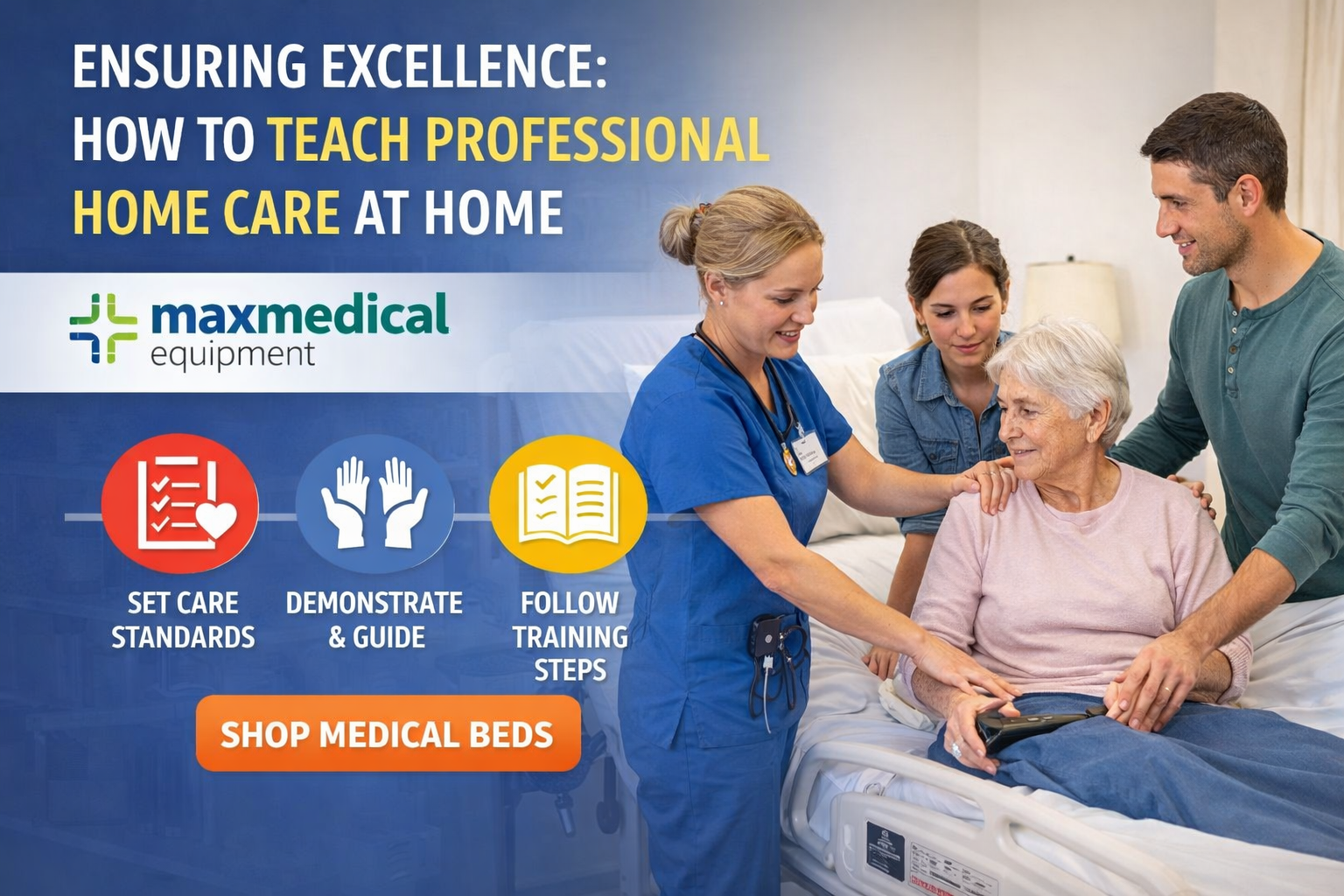
Ensuring Excellence: How to Teach Professional Home Care at Home
- by Mike
- 0 Comments
Giving professional-grade care at home is a great service. At Max Medical Equipment, we think that any family can learn and succeed in those basic skills! Creating a safe, healing environment doesn’t require a medical degree. But for that, you need a process—and professional resources.
This guide will help you balance hospital standards with home comfort. Your family will be safe, you’ll master the equipment you can afford, and we encourage long-term financial planning.
Establishing the Benchmark for Home-Based Treatment
The first step in teaching home care is to determine the physical environment. You need to convert a typical bedroom into an adequate recovery suite. First, clear away anything that would impede movement or equipment. Open floor space enables caregivers to move freely around the patient.
Creating a Safe Workspace
At Max Medical Equipment, the primary pillar of our training is safety. It is crucial to promptly educate your team on risk awareness. For instance, ensure that all electrical cords are intact and without loose connections. Plenty of bright, glare-free light is also important for monitoring skin changes or reading labels.
The Role of Ergonomics
The health of the caregiver is as important as the health of the patient. Teaching appropriate body mechanics helps to prevent long-term strain and injury. Your feet should always be shoulder-width apart while assisting someone else to move. Also, never twist your torso while loading. Use even, steady movements to maintain stability for all parties.
- Maintain a clean and organized working area.
- Store commonly used supplies at waist level.
- Make sure the way to the bathroom is always lit up.
- Install nonslip rugs in all wet areas.
- Designate an area around the medical bed as a “no-clutter” zone.
- Mastering Medical Equipment Logistics
Having the right tools is crucial for any caregiver. At Max Medical Equipment, we guide families through the intimidating world of medical equipment. The first step to greatness is understanding your options.
Evaluating Your Bed Options
Selecting the correct bed is a key choice for long-term comfort. Most families initially investigate the hospital bed rental price in their area. There are different prices depending on the automation level and the rental time. In general, renting is a great way to trial high-end features without having to make a huge up-front investment.
When weighing hospital bed rental vs. purchase, think about the expected length of recovery. A flexible rental agreement is almost always best if you have short-term needs. Chronic conditions, on the other hand, could make buying more economical over a few years.
Ensuring Skin Integrity
Good bedding is more than just a place to sleep. It’s about avoiding complications such as pressure injuries. For most home setups, we highly encourage a hospital bed with a mattress rental package. Such specialized mattresses redistribute body weight with air or high-density foam. It is why they can help support skin health for an immobile patient.
Advanced Training for High-Need Situations
A few care situations call for additional force and explicit measurements. The emotional support you provide must also be tailored to the unique physical needs of your loved ones.
Handling Bariatric Care Requirements
Standard kits typically have weight limits that may be insufficient for heavier individuals. If you happen to be caring for a heavier person, safety is your number one priority. A bariatric hospital bed rental for its reinforced frame and greater surface area. These devices provide support during transfers and rest the user in a safe and secure position.
- Ensure that all lifting devices are not overloaded.
- Make sure the room doorway will accommodate bariatric frames.
- Slide sheets with a heavy-duty design make repositioning even easier.
- Promptly check that the motor for buoyancy of the bed is working well.
- Educate multiple caregivers on assisted bariatric transfers.
- The Importance of Turning Schedules
It is professional care that is consistent. You have to teach your home team the importance of a tight turning schedule. (Rotating the patient every 2 hours helps with this.) Keep a log of these movements with an old-school log or a timer. Additionally, lay pillows underneath them to help “float” heels and avoid friction between bony prominences.
Financial Management and Resource Allocation
Navigating a home care budget is a long-distance race, not a sprint. At Max Medical Equipment, we urge families to analyze the full cost of care.
Tracking Ongoing Expenses
In several months, the medical supplies would be astronomical. Maintain a meticulous log of all rental fees and consumables. You can gauge your monthly requirements by being aware of the precise hospital bed rental prices. Stop making educated guesses; use solid data to make smart financial decisions.
When to Pivot Your Strategy
As the patient’s condition changes, you may have different equipment needs. Evaluate hospital bed rental vs. purchase periodically to ascertain whether your current solution is still viable. Keep in mind that sometimes you need a better model to get the results. With rentals, you can make these transitions without the maintenance and ownership cost of obsolete equipment.
- Check your lease every three months.
- Inquire about “rent-to-own” programs for long-term needs.
- Ask about discounts for bundling multiple pieces of equipment.
- You also have to consider the cost of professional cleaning and maintenance.
Teaching Daily Living Support
Home care involves more than operating machines. It is about the human aspect of everyday life.
Hygiene and Dignity
Good hygiene is also crucial for mental health. Train your caregivers in how to do bed baths properly but respectfully. Preference for warm water and pre-moistened or pH-balanced wipes. Moreover, always keep the patient’s body covered except for the area being cleaned.
Nutrition and Hydration
A body that’s healing needs regular fuel and fluids. Keep a close eye on intake and track it in a daily care journal. Advise on the food consistency according to specialist advice if there is any swallowing issue in the patient. In the meantime, keep a fresh glass of water within arm’s reach of the bed.
- Provide little meals throughout the day.
- Spoon Buddies: Use adaptive utensils for increased independence.
- Monitor fluid intake to avoid dehydration.
- Post both a list of foods that are off-limits and any allergens.
- Make them sit up straight when eating to avoid choking.
Sustaining the Caregiver
Providing excellent care is absolutely dependent on supporting caregivers. At Max Medical Equipment, we witness families driving themselves into the ground.
Preventing Burnout
You have to educate your team that taking breaks is not weak. Competitive inclusion into the health system is a key to guaranteeing top-notch care. Schedule “respite” hours in which someone else takes over the duties. In turn, the primary caregiver is returning back refreshed and reinvigorated.
Building a Support Network
Don’t try to do it all yourself. Contact local support groups or online forums. Emotionally, it can help a lot to share your experiences with people in the same boat. Also work with your equipment provider, who can help answer technical questions.
Conclusion
The journey of teaching professional home care is one of continuous improvement. Opting for a hospital bed with mattress rental gives you the best support for sleeping. Whether you require a standard setup or even a bariatric hospital bed rental, quality equipment is essential.
Here at Max Medical Equipment, we’re dedicated to helping your family do just that. So adhere to these protocols, and stay organized and safe at all times. You just need the right training to be able to deliver a level of care that can rival a clinical setting.